
A full-time intensive English course at Excel Language Center means 7 hours of English a day, Monday to Friday. A typical day has 4 hours of academic skills in the morning, a short break, 1 hour of activities and real-life practice, a lunch break and a 2-hour speaking class. Over a week that is 35 hours of English, and most students move up one level every month.
Many students ask us the same question before they come: "Seven hours? Is that too much?" This guide shows what each part of the day is for, what students actually do, how the hours turn into progress, and how to keep your energy up. It describes our main programme, the Excel Intensive English Experience (EIEE), taught at our Kuala Lumpur and Serdang campuses.
What does a day in an intensive English course look like?
Every part of the day has a different job: the morning builds accuracy, the activity hour puts it to use, and the afternoon builds fluency. This is the sample daily structure published for the EIEE:
| Part of the day | Time | What you do |
|---|---|---|
| Academic skills | 4 hours | Grammar, reading, writing, listening and pronunciation at your level |
| Break | 15 minutes | Rest, coffee, talk with classmates |
| Activity and interactive practice | 1 hour | Simulation Street, Excel Passport missions and group tasks |
| Lunch break | Lunch | Eat with classmates from other countries (in English) |
| Speaking class | 2 hours | Discussions, presentations, role plays and fluency practice |
Seven hours sounds long, but the day is not 7 hours of sitting and listening. The activities change through the day, and a large part of the day is you talking, not the teacher.
What happens in the 4 hours of academic skills?
The morning is the structured core of the course. Each level follows a clear syllabus, so you always know what you are learning and why. The curriculum covers:
- Grammar for the level, taught through examples and used straight away in sentences.
- Reading and writing, from short everyday texts at the start to academic reading and writing at the higher levels.
- Listening with recordings and real conversations.
- Pronunciation and fluency, so people understand you easily.
- IELTS skills, built in gradually at every level, so students who later take IELTS already know the task types.
Teachers correct you every day and give you feedback on your work. Your progress is checked through level evaluations, so moving up is based on what you can do, not only on time spent in class.
What is the activity hour for?
The activity hour is where English leaves the textbook. Depending on the day and your level, it can be Simulation Street, a mission from your Excel Passport or an interactive group task.
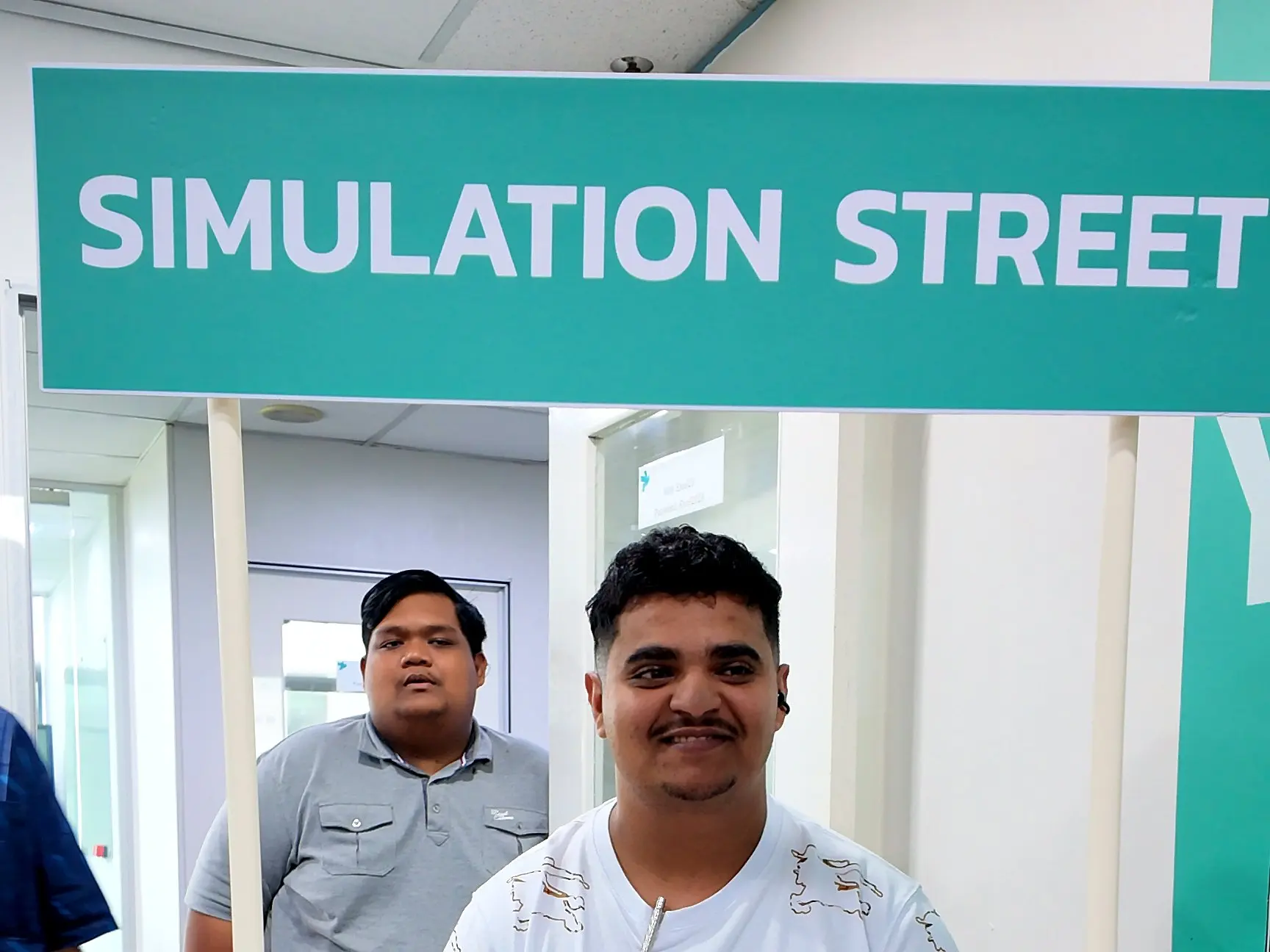
Simulation Street is a real-world practice area inside the campus, with a mock café, office, shop and reception desk. Students use it to practise situations they will meet outside class, such as:
- Ordering coffee and asking about prices.
- Checking in at a hotel front desk.
- Taking part in a job interview.
- Finding their way at an airport or train station.
Every student receives an Excel Passport at their level. It has missions to complete, a place to track your progress and achievements to unlock as you move up. Many students like it because it turns the month into clear, small goals.
What happens in the 2-hour speaking class?
The afternoon speaking class is about fluency: speaking longer, faster and with more confidence. The class is built around structured speaking workshops: discussions, role plays and short talks at your level. Teachers listen, note the mistakes that repeat, and give you better ways to say the same thing.
Because classes mix students from many countries (our students come from more than 40 countries), English is the only language everyone shares. That is the real advantage of studying abroad: you have to use English at lunch, in the corridor and after class, not only in the lesson.
How fast will you move up?
The EIEE has 12 levels, and students complete one level a month. You can study from 1 to 12 months, depending on your starting level and your goal.
| Stage | Levels | What it usually means |
|---|---|---|
| Beginner | 1 to 2 | First words, simple sentences, everyday basics |
| Elementary | 3 to 4 | Short conversations about daily life |
| Pre-Intermediate | 5 to 6 | Talking about past events and plans with more confidence |
| Intermediate | 7 to 8 | Longer conversations, opinions, simple essays |
| Intermediate Plus | 9 to 10 | Academic reading and writing, preparation for exams such as IELTS |
| Advanced | 11 to 12 | Fluent, accurate English for university and work |
Before you start, you take the free English level test so you join the right level from the first day. If you want to reach a certain level by a date (for example before a university application), count the months from your result: each level is about one month of full-time study.
Is 7 hours a day too much? How to keep your energy
Most students feel tired in the first week. That is normal: your brain is working in a new language all day, often in a new country. By the second or third week, the rhythm feels natural. These habits help:
- Sleep well. A regular bedtime makes a bigger difference than any study trick.
- Use the breaks. Stand up, drink water, eat something, and talk to a classmate rather than looking at your phone.
- Review a little every evening. 20 to 30 minutes is enough: read the day's notes and say five new phrases out loud.
- Speak from day one. Mistakes are part of the course. Teachers expect them and correct them kindly.
- Ask for help early. If something is too hard or too easy, tell your teacher. Our academic team monitors progress and gives guidance.
What do students do after class?
The study day ends, but English does not. Excel organises optional activities on campus and outside: cultural events, group outings, sports, social gatherings and speaking clubs. There are also optional group trips during the year, for example to Langkawi, the Cameron Highlands, Malacca and around Kuala Lumpur. All trips and activities are optional, and details are shared in advance.

These activities are where many students make their best friends, and they are an easy way to practise English without the pressure of a class. See what is on in Social Activities and Trips.
How Excel helps you settle into the intensive rhythm
Your first week is designed to make the long days easy to start. Every new student receives a campus orientation, an academic briefing, a level confirmation and a student handbook, and has a dedicated support contact for the first week. Our team also helps with practical life in Malaysia: accommodation guidance, local transport advice and clinic referrals. Read more on our Student Support page.
Here is how to start:
- Take the free English level test online. It is marked by Excel.
- Choose your start date. New classes start every month; see the academic calendar.
- Book a free consultation. We will explain the programme, the course fees for your study length and, if you need one, the student visa steps.
Frequently asked questions
How many hours a week is an intensive English course at Excel?
35 hours. The EIEE runs Monday to Friday, 7 hours a day. That is around 140 hours of English in a four-week month, far more than a typical evening or weekend course.
I am a beginner. Can I follow 7 hours of English a day?
Yes. You start in the level that fits you after the English level test. Teachers at Excel work with beginners every month and use clear explanations, body language, pictures and step-by-step practice, so you are not expected to understand everything on the first day.
Can I choose only the morning or only the speaking class?
The EIEE is designed as one full-time programme, and the parts support each other. If you need a shorter schedule, ask us in a free consultation and we will tell you which options fit your plans. Excel also runs live online classes for students who cannot travel yet.
Is there homework after 7 hours of classes?
The main work happens in class, so your evenings stay free. We suggest 20 to 30 minutes of review in the evening, such as reading the day's notes and repeating new phrases out loud, to remember more of what you learned.
When can I start?
New classes start every month. Upcoming start dates are 1 December 2026, 4 January 2027 and 2 February 2027. The academic calendar on our website always shows the next dates.
Does the intensive course help with IELTS?
Yes, as a foundation. IELTS skills are built into every level of the EIEE, and Excel also has a separate IELTS preparation course for students who are close to the score they need.
Sources
- Excel Intensive English Experience (EIEE): course structure, levels and sample day, Excel Language Center
- Student Support: orientation, academic support and student care, Excel Language Center
- Social Activities and Trips, Excel Language Center
- Academic Calendar: intake dates, Excel Language Center